
The very violent eruption of Tarawera, was one of the most notable events of the 19th century in New Zealand. That eruption was heard over most of the country; about 108 people were killed, and the world-renowned White and Pink Terraces were utterly destroyed.
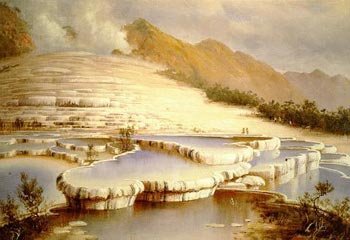 Charles Blomfield - The White Terrace
Alexander Turnbull Library
The White and Pink Terraces at Lake Rotomahana had aroused worldwide attention once the first pakehas to see them (in the 1840s) had reported their existence. An organised tourist industry flourished at Te Wairoa village from about 1872, and by 1886 no visit to the Antipodean colonies was considered complete without the climactic experience of bathing in the uniquely beautiful hot pools of the Terraces.
Victorian travellers recorded their experience in a rich legacy of art, photographs and words.
Writer Anthony Trollope enjoyed a bath in one of the pools of the Pink Terrace in 1874:
"In the bath, when you strike your chest against it, it is soft to the touch, you press yourself against it and it is smooth.....The baths are shell-like in shape, like vast open shells, the walls of which are concave and the lips ornamented in a thousand forms."

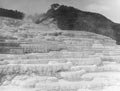

Images Courtesy of Alexander Turnbull Library
On 1 June 1886, a party of tourists claimed to have seen a Māori war canoe appear out of the mists on Lake Tarawera. It was being paddled by Māori in traditional dress, and disappeared when only half a mile from the tourist boat.
A tohunga or Māori priest in Te Wairoa claimed that it was a waka wairua, or spirit canoe, and that it was an omen of a great calamity, which would strike the land.
There are eye witness reports of the eruption.

 Destroyed by the eruption of Mt Tarawera in 1886, the village of Te Wairoa is today a living museum where visitors can experience a unique piece of New Zealand history.
Buried Village
 The crater of Mount Tarawera as seen today.
3 comments:
Grampapinhead, I am glad you are enjoying a little NZ history.
This is a beautiful website, it helped me a lot in social studies but one thing you could do for this is not take stuff from this website: https://bit.ly/2OOkt8Q
Kind regards from Me~
XD
This helped me so much you are a life savior, my project got an excellence, thank you, thank you for making this, you have saved my life
- thank you, Lon Lee
Jk
plagiarized this from here https://www.biblio.com/book/volcanic-eruption-tarawera-new-zealand-resulting/d/503910499 XDDDDDD
Post a Comment